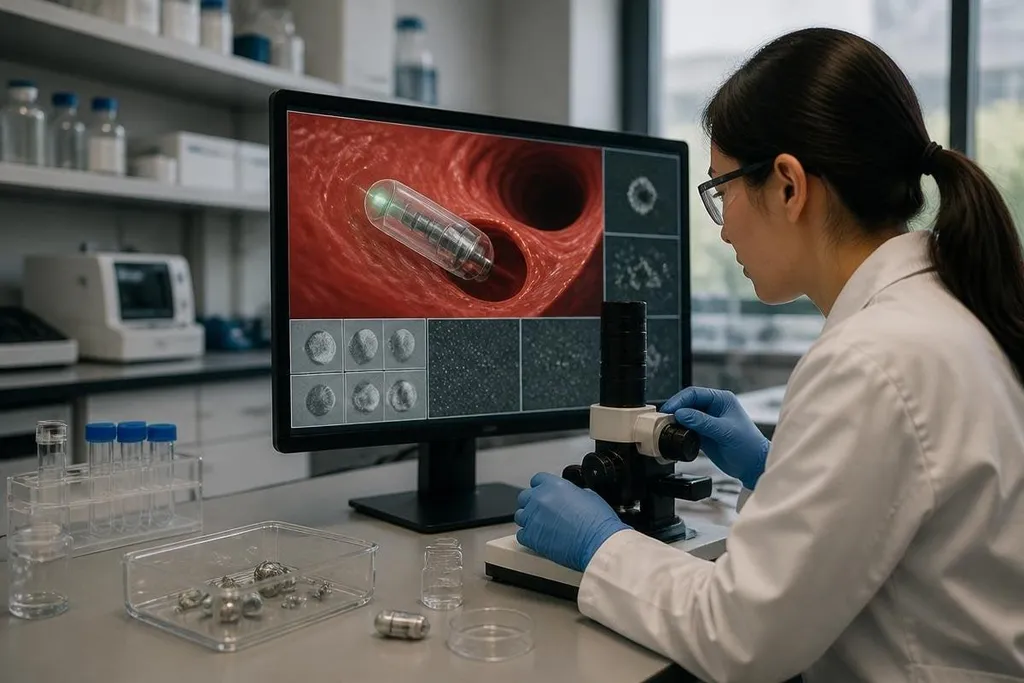
A tiny medical robot may fit inside a blood vessel, but reaching the right place is only one part of the job. The harder test is releasing medicine safely, proving where the robot went, and removing it afterward.
Quick read
- Microrobots can be guided by magnetic fields, light, sound, or chemical reactions.
- Drug release must happen at the target site, not during the trip.
- Medical approval will depend on tracking, control, safety, and removal.
How the robots would move
The phrase “tiny robot” covers several designs. Some are small particles that carry medicine. Others use moving parts, magnetic material, or a soft body that changes shape when a doctor applies an outside force.
Magnetic control is easy to describe. A magnetic field outside the body can pull, spin, or steer a robot that contains magnetic material. The hard part is control: blood flow, tissue movement, and the robot’s changing position can all affect its path.
Light and ultrasound offer other control methods. Light may work near the body surface, while ultrasound can send energy through tissue. Each method brings limits tied to depth, heat, visibility, and the type of tissue in the way.
A medical team would also need to track the robot during treatment. X-ray imaging, ultrasound, magnetic resonance imaging, or another method could show position, but the choice depends on the robot’s material and the part of the body being treated.
Those choices affect what the robot can do inside the body, from staying visible to reaching the treatment site. Robot24.com medical robotics reports can place a machine’s material, imaging method, and clinical test beside claims about its use.
What medicine would ask the robot to do
Drug delivery is the clearest use. A robot could carry a medicine through the body and release it near a tumor, a blocked vessel, or another target. That idea could reduce exposure in healthy tissue, but only if the robot stays on course and releases the right dose.
The release step needs its own design. A coating could break down after a chemical change. A magnetic part could open a small chamber. Heat, light, or a change in acidity could trigger the medicine. Each method must work inside the body without harming nearby cells.
Another design could carry a sensor or collect a small sample. That would turn it into a moving tool for diagnosis, but the robot would need enough power, a safe material, and a way to send data back out.
These tasks are different from delivering a parcel across a room. A doctor needs to know the robot’s location, its condition, and the amount of medicine left inside it. The treatment plan cannot depend on a device that disappears from view.
Where the idea can fail
The body is a difficult place for a small machine. Blood flow can push it away from its target. Narrow vessels can block movement. The robot may stick to tissue, break apart, or trigger an immune response.
Size creates another problem. A smaller robot may reach tighter spaces, but it has less room for a battery, sensor, control circuit, or medicine. A design that works in a dish may have no practical way to work inside a person.
Removal matters too. If the robot stays in the body after treatment, it creates a new medical problem. Doctors would need to retrieve it, dissolve it safely, or prove that its material leaves the body without causing harm.
The evidence standard is high because a mistake inside the body can injure someone. A credible report should name the robot’s material, size, control method, drug load, tracking method, and test setting.
Claims about treatment need results from the right biological test, not a computer model alone.
A buyer’s check for medical robot claims
Use this list when a lab, company, or video presents a tiny medical robot:
- Name the setting: Was the test done in a fluid channel, animal tissue, or a human body?
- Check the control: What steers the robot, and how does the operator know its position?
- Ask about the payload: How much medicine does it carry, and how is release measured?
- Find the exit plan: Can doctors remove the robot, or does the material dissolve?
- Read the safety result: Look for tissue damage, immune response, heat, and blocked vessels.
I'd treat any claim of near-term treatment with care until those details are public.
The next useful milestone is not a smaller robot. It is a full test that links steering, tracking, drug release, safety, and removal in one medical setting.